What an LGP panel is and how it works
A light guide plate (LGP) is a modern edge-lighting technology widely used in the production of all kinds of lighting products, including advertising media.
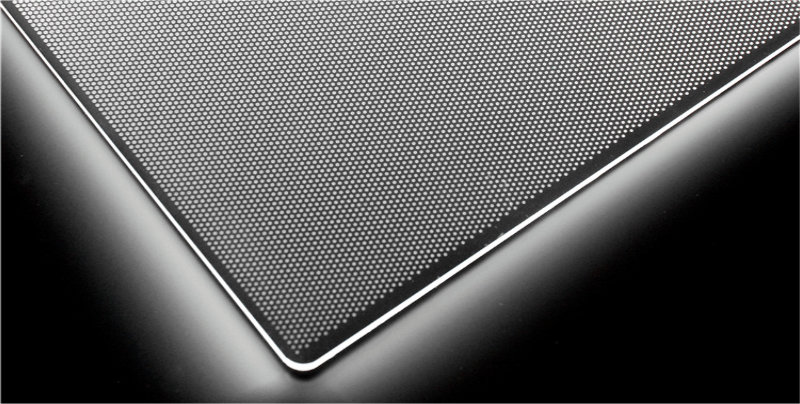
The technology is based on placing LEDs along the edge of a clear sheet material (acrylic), whose inner surface carries a special engraving made up of micro-lenses: irregularities of various shapes (dots, scratches, lines).
Light entering the sheet spreads evenly across its entire area, and when it hits a micro-lens it exits the sheet.
Edge-lighting diagram:
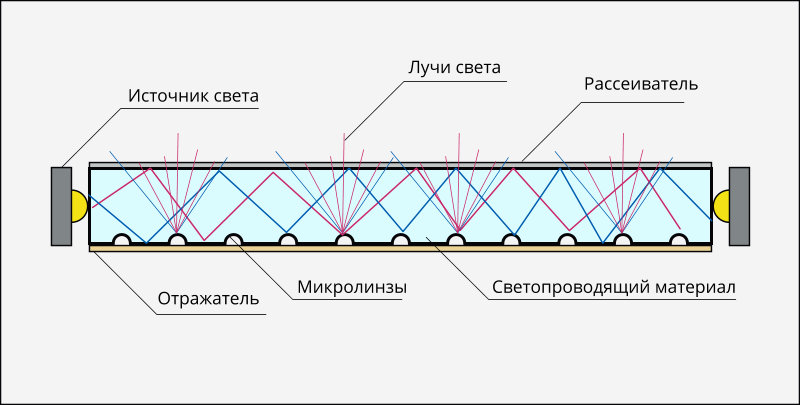
For an LGP panel to work properly, you need:
- the LGP panel itself;
- light sources (LEDs);
- a diffuser and a reflector.
Where LGP panels are used
They are widely used wherever even illumination needs to be combined with minimal thickness, for example in slim light panels such as frame lights of 3 main types (“Crystall”, “Magnetic” and “Click”). They are also used for:
- slim lamps of various configurations, including for spaces with high lighting quality requirements;
- interior design;
- illuminated shelves;
- lighting kitchen splashbacks (skinali): special inserts in the kitchen wall in the form of decorative panels and sheets of various materials used as the final cladding.
How light-diffusing panels are made
- V-CUT: a grid of lines is engraved on acrylic using engraving equipment.
- UV printing on acrylic.
- DOT-PRINT: screen printing on acrylic with special inks that etch its surface layer.
- From ready-made acrylic with micro-particles embedded during manufacture.
- From acrylic with micro-lenses applied by extrusion (forcing the material through a shaping die).
- Using self-adhesive film with dots. This method was inefficient and is now obsolete, so LGP manufacturers have abandoned it.
- Using a universal laser pattern: dots in a regular pattern are laser-engraved.
- Using a laser pattern made to size: dots are engraved by engraving equipment to a specially designed pattern.
Basic rules for working with LGP
1. Thickness:
- for products up to 600 mm wide, a 3 mm panel can be used;
- for products 600–1200 mm wide, a 4 mm panel;
- a panel thicker than 4 mm is only justified by the rigidity or specific design of the product.
A 25–30% drop in brightness from the edges to the centre of slim light boxes is considered perfectly acceptable, as it is practically unnoticeable even on a plain white field.
A drop in brightness of even up to 50% is equally acceptable and unnoticeable when lighting non-uniform images (such as paintings, portraits or drawings).
2. Light source requirements
The edge of the panel must be clear and free of any defects. The LEDs must be in the closest possible contact with the edge of the panel and precisely centred on it.
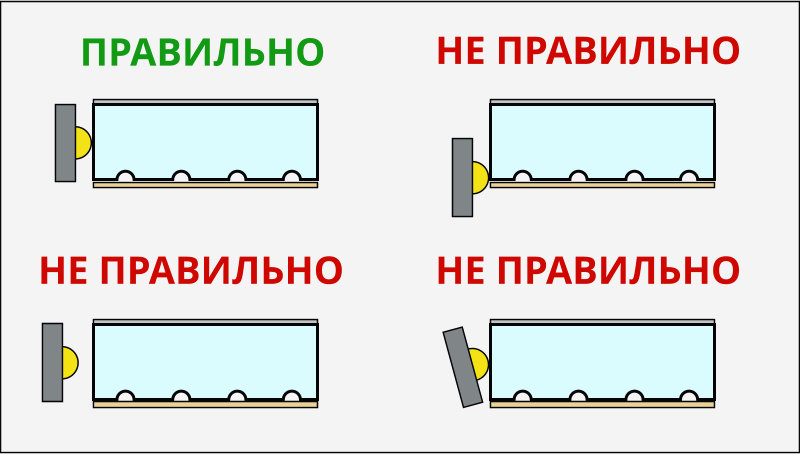
Even a gap of just 1 mm between them reduces brightness by about 25%.
That is why rigid LED strips work very well for edge lighting: they sit flush against the acrylic edge and do not deform it, as they give off little heat.
We recommend lighting the panel from one side only for small products. In this case, the opposite unlit edge is covered with reflective film.
3. Reflector
A special lighting reflector (a very thin, opaque material on a roll) is of course preferable, but ordinary white PVC can be used instead without any problems.
If the panels emit light on both sides, the diffuser acts as the reflector.
4. Diffuser
In most cases the diffuser is backlit film, a translucent material that spreads light evenly over the entire surface.
Other special diffusers can increase brightness by a further 5–7%, but they are only needed in slim lamps where every percent of efficiency matters.
5. Assembly rules:
- Handle the LGP panel with great care, as edge lighting shows up any defect, whether a scratch or a fingerprint. Rubber gloves are advisable.
- If careless handling does leave small scratches, they can be removed with a blowtorch, but only where there are no micro-lenses.
- Remove the protective film from the LGP at the very last moment.
- Never stick anything to either side of the panel! Even under clear protective film it will stop emitting light. The reflector and diffuser are fixed only around the perimeter.
- When installing advertising light panels (such as crystal light panels, “floating” designer lamps and other structures), we recommend a special conductive cable with copper cores, which reduce its electrical resistance while keeping it strong. As a result, brightness does not drop significantly even on long cables.
- Several LGP panels used together are a good way to light large light boxes. In this case, the diffusing surface must be mounted at a distance of about 25 mm from the panel.



-
 About us
-
![Contacts]() Contacts
Contacts
-
![Payment]() Payment
Payment
-
![DELIVERY]() DELIVERY
DELIVERY
-
![Gallery]() Gallery
Gallery
-
![For designers]() For designers
For designers
-
![Print-ready artwork requirements]() Print-ready artwork requirements
Print-ready artwork requirements
-
![Aluminium composite colour range]() Aluminium composite colour range
Aluminium composite colour range
-
![Chipboard colour palette in stock]() Chipboard colour palette in stock
Chipboard colour palette in stock
-
![Artwork approval rules]() Artwork approval rules
Artwork approval rules
-
![LED neon colours]() LED neon colours
LED neon colours
-
![Artwork design]() Artwork design
Artwork design
-
![RAL colour chart]() RAL colour chart
RAL colour chart
-
![Pantone colour chart]() Pantone colour chart
Pantone colour chart
-
![Series 641 – economy]() Series 641 – economy
Series 641 – economy
-
![Altuglas coloured acrylic palette]() Altuglas coloured acrylic palette
Altuglas coloured acrylic palette
-
![Two-layer plastic colour palette]() Two-layer plastic colour palette
Two-layer plastic colour palette
-
![Useful articles about advertising]() Useful articles about advertising
Useful articles about advertising
-
 Company documents
  Contacts
  Payment
  DELIVERY
  Gallery
  For designers
  Print-ready artwork requirements
  Aluminium composite colour range
  Chipboard colour palette in stock
  Artwork approval rules
  LED neon colours
  Artwork design
  RAL colour chart
  Pantone colour chart
  Series 641 – economy
  Altuglas coloured acrylic palette
  Two-layer plastic colour palette
  Useful articles about advertising