Thread milling
Thread milling
Thread milling is a method of cutting threads with a multi-tooth rotating tool. There is a fixed kinematic link between the linear and rotary feed motions of the workpiece. A distinction is made between short-thread milling and long-thread milling, for both external and internal threads. Thread milling is cost-effective for external threads from 4 mm in diameter and internal threads from 8 mm in diameter. It is used primarily for workpieces that are difficult or impossible to machine with other threading methods.
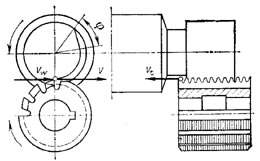
In the classic method (Fig. 54), both the cutter and the workpiece rotate, and within one-sixth of a revolution the cutter is fed radially to the full depth of the thread profile. After one more revolution of the workpiece the thread is complete. During this time the tool or the workpiece moves axially by one thread pitch. Up (conventional) milling is preferable in this case.
|
Fig. 54 |
Fig. 55 |
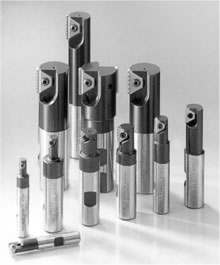
KENNAMETAL HERTEL TMS thread milling cutters (Fig. 55) can machine threads on very large parts; on parts that are difficult or impossible to clamp in a lathe for single-point threading; on asymmetric parts with significant imbalance when rotating; in blind holes without thread relief grooves; and with very large thread diameters. Compared with other threading methods, the TMS system offers certain advantages. First and foremost, machining time is reduced thanks to high cutting speeds and feeds, complete machining in a single operation, and a full-depth thread profile in a single pass. Short, easily removed chips reduce the non-productive time spent on chip removal. Tool inventory can also be reduced, because one tool is used for both left-hand and right-hand threads; one cutter body serves for external and internal threads as well as for threads of different profiles and pitches; each insert has two cutting edges; and the inserts carry a wear-resistant coating that extends their tool life. The KENNAMETAL HERTEL TMS system is thus a complete solution for high-precision, cost-effective thread milling in all applications.
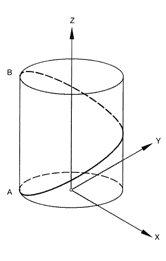
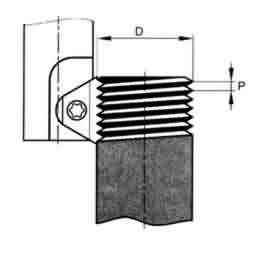
TMS cutters require a milling machine with simultaneous CNC control of three axes (helical interpolation). Helical interpolation is the ability to move a point along a helix. Helical motion consists of circular motion in one plane combined with simultaneous displacement perpendicular to that plane. The movement from point A to point B (Fig. 56) is exactly such a combination of circular motion in the XY plane and linear movement along the Z axis. In thread milling (Fig. 57), the circular motion produces the thread diameter (D) and the linear movement produces the pitch (P). Helical interpolation combined with the required insert profile produces all the thread parameters.
|
Fig. 56 |
Fig. 57 |
This method can produce internal and external, right-hand and left-hand threads. Different threads are obtained through different combinations of direction of rotation and feed (Fig. 58). Climb (down) milling should be preferred, as it gives lower cutting forces, better chip formation, a better surface finish and longer tool life. For internal threads in blind holes it also reduces the risk of the cutter jamming against chips lying in the hole. At the same time, when machining hardened surfaces or difficult-to-machine materials, up milling is sometimes the better choice.
When choosing a tool for internal thread milling, the decisive factor is being able to select the largest cutter diameter for the given hole diameter. Cutters with two cutting edges halve the machining time. Small-diameter cutters also reduce machining time and improve cooling and chip evacuation, but their lower rigidity can cause vibration, especially when machining high-strength materials. Inserts whose cutting edge is longer than the thread to be machined should also be preferred, so that the thread can be machined in a single revolution. If this is not possible, machine one revolution, shift the cutter by several thread pitches and mill the next revolution.
|
Fig. 58 |
Fig. 59 |
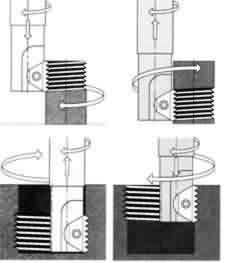
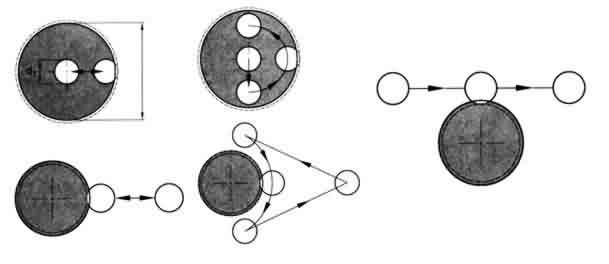
There are three infeed methods in thread milling: radial entry, tangential arc entry and tangential straight-line entry. With radial entry (Fig. 59a), the tool approaches the part in a straight line towards its centre. This is the simplest method but also the least favourable, because the angle of engagement is too large. It should only be used in exceptional cases. Tangential arc entry (Fig. 59b) is the preferred method. The tool approaches the part in rapid traverse, stopping 0.5 mm short of it. From this point it moves along an arc while simultaneously feeding along the Z axis to the full profile depth. After one full revolution, the cutter is withdrawn in the same way. With this method the tool enters and exits the material smoothly. Tangential straight-line entry (Fig. 59c) is very simple and has all the advantages of tangential arc entry, but can only be used for external threads.
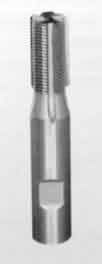
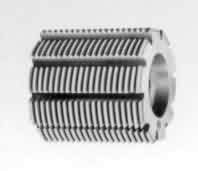
In addition to the KENNAMETAL HERTEL thread milling system with indexable inserts, solid carbide and HSS thread mills (Fig. 60) and shell-type HSS multi-form (comb) thread mills (Fig. 61) are also used. The technique for using these cutters is exactly the same as described above for cutters with indexable inserts. Experience shows that in most applications indexable inserts offer an economic advantage, although in certain cases multi-form cutters are justified. One example is threading without a machine capable of helical interpolation: since the working length of a multi-form cutter is in some cases greater than that of an indexable insert, the thread can be machined in a single operation without axial feed.
In long-thread milling, the length of the thread on the workpiece does not depend on the width of the cutter, which makes it possible to produce very long threads. Disc-type form cutters are used as the tool (Fig. 62). The cutter axis is tilted relative to the part according to the thread pitch (Fig. 63). When cutting internal threads, the thread length is limited by the tilt of the cutter. Further limitations are imposed by the profile angle. If the angle is less than 10°, the profile is significantly distorted, so square threads cannot be cut by this method. Both climb and up milling can be used: climb milling gives longer tool life, while up milling gives higher accuracy and a better surface finish.
Thread profiles can also be produced by generating (hobbing), in the same way as gears. This method is cost-effective for multi-start threads with a coarse profile, such as worms.
|
Fig. 60 |
Fig. 61 |
Fig. 63 |
Fig. 62 |




-
![About us]() About us
-
![Contacts]() Contacts
-
![Payment]() Payment
-
![DELIVERY]() DELIVERY
-
![Gallery]() Gallery
-
![For designers]() For designers
-
![Print-ready artwork requirements]() Print-ready artwork requirements
-
![Aluminium composite colour range]() Aluminium composite colour range
-
![Chipboard colour palette in stock]() Chipboard colour palette in stock
-
![Artwork approval rules]() Artwork approval rules
-
![LED neon colours]() LED neon colours
-
![Artwork design]() Artwork design
-
![RAL colour chart]() RAL colour chart
-
![Pantone colour chart]() Pantone colour chart
-
![Series 641 – economy]() Series 641 – economy
-
![Altuglas coloured acrylic palette]() Altuglas coloured acrylic palette
-
![Two-layer plastic colour palette]() Two-layer plastic colour palette
-
![Useful articles about advertising]() Useful articles about advertising
-
 About us
 Company documents
 Contacts
 Payment
 DELIVERY
 Gallery
 For designers
 Print-ready artwork requirements
 Aluminium composite colour range
 Chipboard colour palette in stock
 Artwork approval rules
 LED neon colours
 Artwork design
 RAL colour chart
 Pantone colour chart
 Series 641 – economy
 Altuglas coloured acrylic palette
 Two-layer plastic colour palette
 Useful articles about advertising