Artwork requirements for large-format printing
- File format: TIF or EPS
- Resolution: 150 dpi
- Scale: the file must be at 1:1 scale
For prints over 3 m, the permissible tolerance is 1 cm per 1 m of the finished product's length.
For prints under 3 m, the permissible tolerance is 5 mm per 1 m of length.
- Layers: a single layer only (Background). All other layers must be deleted;
- Colour mode: CMYK
- Black: rich black (C-70%, M-70%, Y-70%, K-100%)
The Customer bears full responsibility for:
- the design of the artwork;
- spelling mistakes in the text;
- defects in raster images
Exact colours
Bear in mind that the colour gamut of offset printing differs from the gamut achievable in large-format printing. So if your artwork contains colours that must be matched precisely, choose them from the PANTONE™ Process Coated guide and be sure to specify them in the accompanying documents.
Colour is defined by the CMYK percentages at each specific point of the image!
Please note that the following are NOT criteria:
- COLOURS ON THE MONITOR:
An image on a screen and one on a printed material are fundamentally different: in the first case we see emitted light (the RGB model), in the second, reflected light (more natural for the eye).
- COLOURS ON A DESKTOP PRINTOUT:
- Inks for a desktop printer and a large-format plotter differ in chemical composition;
- Ink is applied in different ways;
- The textures of the printed materials themselves differ. This applies above all to printouts from EPSON inkjet printers, whose inks are specially designed to reproduce screen colours (especially on coated inkjet paper). These colours often have no CMYK equivalent — at best they can match to some degree.
Detailed guide to preparing a file for printing:
Print-ready images are accepted in TIF and EPS formats
1. Whatever dpi is used for printing, the resolution of the supplied image must be between 100 and 300 dpi, and the final file must not exceed 300 MB.
2. The artwork must be supplied at 1:1 scale.
For prints over 3 m, the permissible tolerance is 1 cm per 1 m of the finished product's length.
For prints under 3 m, the permissible tolerance is 5 mm per 1 m of length.
3. Files must contain a single layer only: Background. All other working layers must be deleted;
4. The file MUST NOT contain additional alpha channels or paths.
5. When preparing files, do not use black or grey made of black ink only (CMYK 0,0,0,100). In print, such a colour comes out dark grey rather than black, with visible horizontal banding. A grey that is not built from rich black will also band. To avoid this, black must be rich black. Grey produced by shadows must also be derived from rich black.
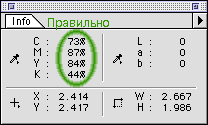 |
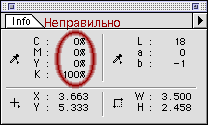 |
6. All colours used in the artwork must be in CMYK mode.
7. Artwork in CorelDRAW formats is NOT ACCEPTED! CorelDRAW has a number of significant drawbacks
8. If your work uses images previously compressed with JPEG (JPEG is a raster format), the print quality will inevitably be unsatisfactory:
- jagged thin lines and object outlines;
- insufficient sharpness / excessive pixelation;
- large flat rectangular blocks appearing on near-uniform fills, etc.
- high JPEG compression is achieved at the cost of a significant loss of image quality, especially at low quality settings, and the image will contain the irreparable defects listed above.
11. Accompanying documents:
- file name;
- image preview (thumbnail);
- image dimensions;
- if the image is to be printed in several parts, state the size of each part and the overlap;
- print material;
- PANTONE™ colours, if required.
- any post-print finishing required.



-
 About us
-
 Contacts
-
![Payment]() Payment
Payment
-
![DELIVERY]() DELIVERY
DELIVERY
-
![Gallery]() Gallery
Gallery
-
![For designers]() For designers
For designers
-
![Print-ready artwork requirements]() Print-ready artwork requirements
Print-ready artwork requirements
-
![Aluminium composite colour range]() Aluminium composite colour range
Aluminium composite colour range
-
![Chipboard colour palette in stock]() Chipboard colour palette in stock
Chipboard colour palette in stock
-
![Artwork approval rules]() Artwork approval rules
Artwork approval rules
-
![LED neon colours]() LED neon colours
LED neon colours
-
![Artwork design]() Artwork design
Artwork design
-
![RAL colour chart]() RAL colour chart
RAL colour chart
-
![Pantone colour chart]() Pantone colour chart
Pantone colour chart
-
![Series 641 – economy]() Series 641 – economy
Series 641 – economy
-
![Altuglas coloured acrylic palette]() Altuglas coloured acrylic palette
Altuglas coloured acrylic palette
-
![Two-layer plastic colour palette]() Two-layer plastic colour palette
Two-layer plastic colour palette
-
![Useful articles about advertising]() Useful articles about advertising
Useful articles about advertising
-
 Company documents
  Payment
  DELIVERY
  Gallery
  For designers
  Print-ready artwork requirements
  Aluminium composite colour range
  Chipboard colour palette in stock
  Artwork approval rules
  LED neon colours
  Artwork design
  RAL colour chart
  Pantone colour chart
  Series 641 – economy
  Altuglas coloured acrylic palette
  Two-layer plastic colour palette
  Useful articles about advertising