| Photo |
Bit description |
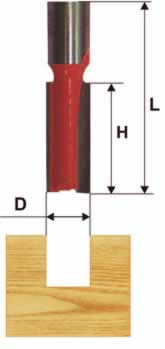 |
Straight (slot) bits are used to cut grooves (slots) of the required width and depth. When working from an edge, the groove width can be changed by adjusting the router fence, without switching to a larger-diameter bit. Straight bits are widely used to make mortise and tenon joints. Tongue-and-groove and double tongue-and-groove joints are used both to make furniture panels and to join workpieces lengthwise
Do not set a cutting depth of more than 7 mm: it is better to make several passes along the workpiece. As for groove width, before using large-diameter straight bits, it is recommended to make a preliminary pass with smaller-diameter bits. In any case, take the router's power into account when choosing the depth of pass and the groove width.
|
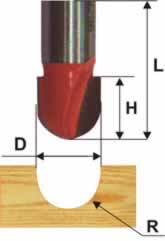 |
Straight (slot) bits are used to cut grooves (slots) of the required width and depth. When working from an edge, the groove width can be changed by adjusting the router fence, without switching to a larger-diameter bit. Straight bits are widely used to make mortise and tenon joints. Tongue-and-groove and double tongue-and-groove joints are used both to make furniture panels and to join workpieces lengthwise.
|
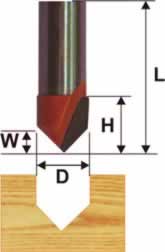 |
Straight (slot) bits are used to cut grooves (slots) of the required width and depth. When working from an edge, the groove width can be changed by adjusting the router fence, without switching to a larger-diameter bit. Straight bits are widely used to make mortise and tenon joints. Tongue-and-groove and double tongue-and-groove joints are used both to make furniture panels and to join workpieces lengthwise.
|
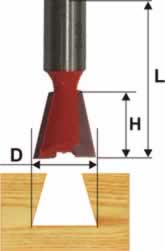 |
Straight (slot) bits are used to cut grooves (slots) of the required width and depth. When working from an edge, the groove width can be changed by adjusting the router fence, without switching to a larger-diameter bit. Straight bits are widely used to make mortise and tenon joints. Tongue-and-groove and double tongue-and-groove joints are used both to make furniture panels and to join workpieces lengthwise.
These bits are used for joints in cabinet furniture, box joints and housing cross rails. They are widely used in restoring antique furniture, since the dovetail joint has long been considered the most beautiful and durable corner joint.
|
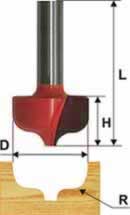 |
Straight (slot) bits are used to cut grooves (slots) of the required width and depth. When working from an edge, the groove width can be changed by adjusting the router fence, without switching to a larger-diameter bit. Straight bits are widely used to make mortise and tenon joints. Tongue-and-groove and double tongue-and-groove joints are used both to make furniture panels and to join workpieces lengthwise.
|
 |
These bits are designed for clean trimming of the edge and end of a workpiece. Mounted in the router, the bit forms a right angle with the router base, so the milled edge or end is strictly perpendicular to the face.
|
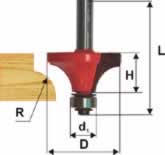 |
These bits let you make joinery, furniture and interior items in a variety of styles, and they are indispensable in restoration work. The wide choice of moulding bit profiles is matched by an equally wide choice of combination bit profiles, so you can keep a consistent style across all joinery work when making furniture and interior elements.
The guide bearing lets you use moulding bits on both straight and curved edges without additional equipment. Enkor bits mainly use 12.7 mm bearings, which makes them more reliable than the 9.5 mm bearings traditionally used by other manufacturers. The 9.5 mm bearing is used to produce an additional profile – a lip.
|
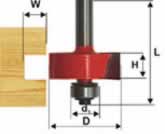 |
Rebate bits are designed for cutting a rectangular rebate, a quarter rebate or a groove along the edge of wooden workpieces. The guide bearing allows both straight and curved workpieces to be milled along their full length. They are used for rebate joints, cutting grooves for door panels, rebating picture frames and rebating cabinet furniture parts.
|
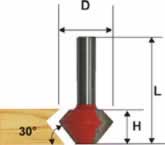 |
Chamfer bits are designed for chamfering the edges of joinery. Besides decorative edging of worktops and cabinet furniture parts, they can cut an angled chamfer along the edges of staves, which are then glued together lengthwise to create multi-sided joinery items such as flower pots, table pedestals, interior columns, and fine decorative household items and furniture.
|
![]() |
Edge profile bits produce a wide variety of edge profiles, either individually or in various combinations. Parts of the bit's cutting edge can also be used separately to create a decorative profile. A router of at least 1600 W is recommended.
|
![]() |
This bit is handy for rounding over and softening edges. It machines both edges at once. Workpiece thickness can be anywhere from 9.5 mm to 38 mm. A router of at least 1600 W is recommended for this bit. The speed must also be reduced to 24000 rpm.
|
![]() |
These bits are used to cut coves on the edge and along the arris. Two bearings make the work easier and more accurate.
|
![]() |
Combination bits are designed for making wooden panels by edge-jointing staves (jointed boards) along their edges and end-jointing joinery parts (lengthening). These bits combine a groove bit and a tongue bit.
Wooden panels for door panels and cabinet furniture parts are made by edge-jointing and end-jointing staves. The strength of a furniture panel depends on the glued area between the staves. Combination bits significantly increase the glued area, improving the physical properties of the panel; in addition, the combined joint aligns the faces of the staves (tongue-and-groove method), giving a flat panel surface and preventing the glued parts from slipping during pressing.
Combination bits are designed for edge-jointing and end-jointing parts. Each bit is used in its own way.
|
![]() |
Tongue-and-groove bits
|
![]() |
The design of combination bits allows the cutting parts to be rearranged for different tasks, making the bit versatile and indispensable in joinery. When the cutters and bearing are repositioned, the bit is not removed from the router collet, so the original bit setting is not lost.
Combination rail and stile bits let you make frame joints for frame furniture, wall panels, interior items, etc.
|
![]() |
Horizontal raised panel bits with a large cutting diameter are designed for decorative edging of panels. The bits have a guide bearing, so both straight and curved edges can be machined.
This bit cannot machine a panel in a single pass, as the cutting edge forms a radius starting right at the bearing and does not create a tongue to fit into the frame groove.
|
![]() |
|
![]() |
These bits are designed for deep milling of joinery edges (panels). They produce a decorative profile and a tongue along the edge of the workpiece in a single pass.
|
![]()
|
Ball nose bit. Used for machining 2D and 3D models; available in diameters of 1, 3 and 6 mm. Suitable for wood, plastic, steel and non-ferrous metals (copper, aluminium, duralumin, brass, etc.) |
![]()
|
End mill (Slot Drill). Mostly used for machining 2D models; diameters of 1, 3 and 6 mm. Main use: 3D roughing. Types of end mills: 2-flute, 3-flute and 4-flute. Suitable for steel, aluminium, duralumin, brass, wood, plastic and textolite. |
![]() |
Conical engraver (V-Bit Engraver). Used for decorative engraving at a set angle. The cutting angle depends on the tool's sharpening. Suitable for wood, plastic and non-ferrous metals (copper, aluminium, duralumin, brass) |
![]()
|
Flat engraver. Available with shank diameters of 1-6. Flat engravers differ in tip diameter and sharpening angle. Used for 2D engraving and 3D finishing. Also suitable for brass, duralumin, aluminium, steel, silver, gold, plastic and wood |





 About us
  Company documents
  Contacts
  Payment
  DELIVERY
  Gallery
  For designers
  Print-ready artwork requirements
  Aluminium composite colour range
  Chipboard colour palette in stock
  Artwork approval rules
  LED neon colours
  Artwork design
  RAL colour chart
  Pantone colour chart
  Series 641 – economy
  Altuglas coloured acrylic palette
  Two-layer plastic colour palette
  Useful articles about advertising